
Trapped in Violence
February 26, 2026
Yakuza 0 is an action-adventure beat-em-up. You’re a badass (as either Kiryu or Majima) who gets to fight hundreds of angry dudes, take their money, and invest it in yourself to better fight the hundreds of angry dudes. It’s a cycle, but a fun one where you get to smash the controller buttons and, if you’re me, shout at the TV. The number of times I have commanded our protagonists to “Get up!” is certainly more than one. It is easy to get caught up in the mini-games (UFO Catcher, anyone?) and absurd sub-stories, too. You get to dance and sing and buy up real estate and help hostesses gain confidence and find solutions for people with bizarre issues.

Yet the main story is the yakuza world, filled with conspiracy and hierarchy and demanding that you try and solve all your problems with your fists. However, beneath this entertaining loop of violence and absurdity, there is a contrast to the beat-em-up we see at the surface level; the game is teaching us something invaluable.
This is what, to me, makes the game worth remembering: Yakuza 0 critiques the very violence it presents. It demonstrates that you can’t solve your problems with your fists. Violence is necessary to survive in the yakuza world, and this violence is how systems of power can trap individuals, make them dependent upon it. It is a cage that goes beyond controlling their actions to controlling their entire framework of understanding choice, identity, and the possibility of something different. We are shown time and again that violence does not progress anything forward. Instead, momentum is gained, the story progresses, and problems are solved through understanding, helping, forgiving, sacrificing, and building community. The game demonstrates that vulnerability and compassion are what build solid foundations from which one may grow.
Being Yakuza Means Being Violent
Yakuza is organized crime. Violence is part of its foundation. We immediately see this in the opening of the game, where Kiryu is beating up a guy for a collections run. When a group terrorizes someone on Kiryu’s family’s turf, we are tutorialized as he beats them up, too. It’s about territorial control. Violence is part of the yakuza job description, the identity that is used to threaten and act upon violence in order to maintain power. Violence is how things are communicated in this world, how hierarchy is established and maintained. It functions as a currency of respect, and we see multiple opponents who admire Kiryu and Majima’s strength when defeated.
Yakuza members do not see their position as one of employment. They cannot set it down or pick it back up at will. It is instead one of identity, the very sense of self they have. It is emotional, social, economic. They are part of a larger family that they have taken oath to. Their tattoos are evidence of the permanence of this yakuza identity.
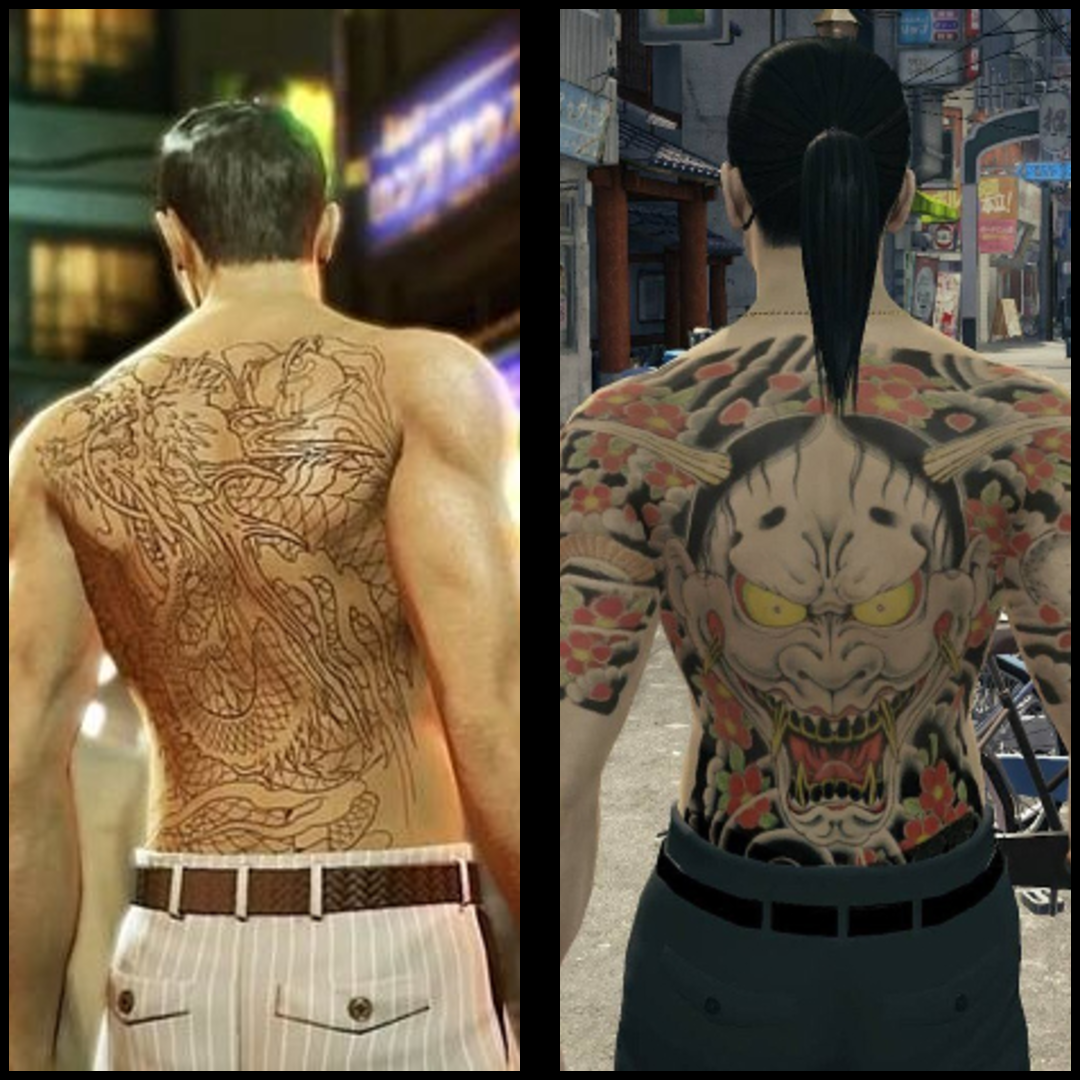
Kiryu becomes “the Dragon of Dojima,” where his reputation precedes him and thus impacts how people see him, treat him, fear him, or respect him. Likewise, Majima becomes “the Mad Dog of Shimano,” a persona that consumes the person it defines. They each become known for their yakuza identity, which helps to trap them in this cycle of violence.
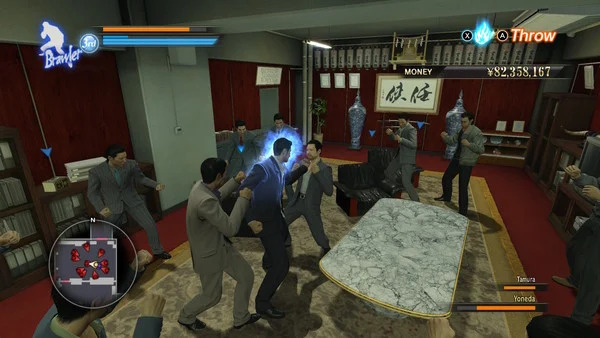
Violence is their identity and in their world, it is a constant. The endless streams of fights just walking down the street are the most basic example. Drunkards, punks, thugs, rival yakuza, people who want to test their strength; they all present you with one option, and that is to fight your way out. You hand their asses to them again and again, achieving nothing of value. Still, the story demands it of you. Want to talk to someone? You gotta fight through their guards. Wanna get information? Gotta fight until they talk. Wanna protect someone? Gotta fight all the attackers.
But it Solves Nothing
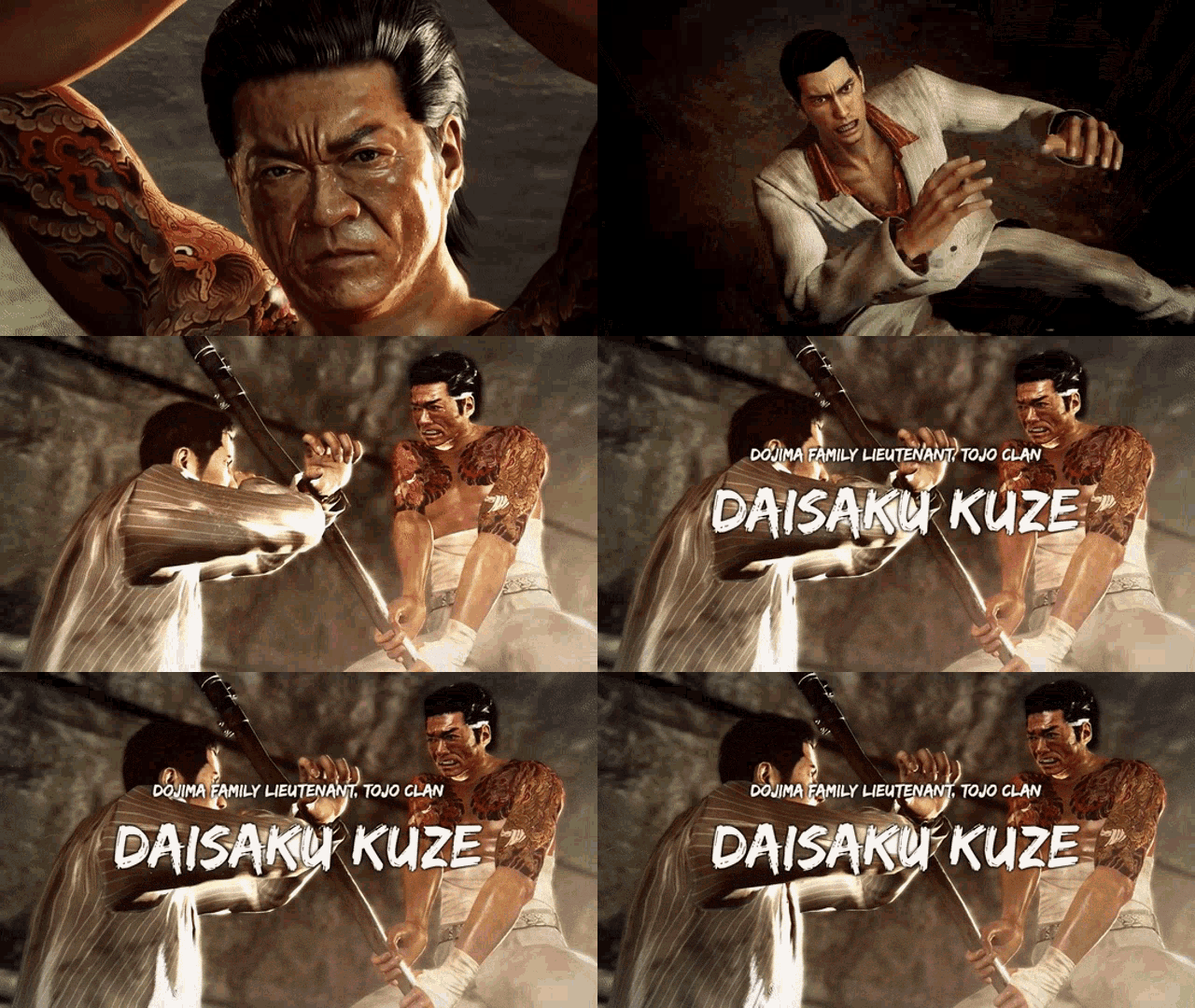
None of the fights in the game really provide any solutions. Violence is something that adds complications and stalls forward movement. The hundreds of angry guys who need their asses handed to them? Yeah, maybe it’s fun, but it doesn’t progress anything. It instead accomplishes making it take longer to progress the storyline. And once we start fighting ‘real’ opponents, we have Yoneda come at us time and again, a foreshadowing of having to fight Kuze five different times. Even once beaten, he just keeps coming back. We wring out five exciting fights, however the story itself does not hinge on these. It is mostly a space for character development and to show the power-hungry, merciless, stubborn underbelly of the organization.
In our individual victories, it feels empowering to have beaten the ‘bad guy.’ But when the game zooms back out to a perspective beyond Kiryu’s or Majima’s fists and nothing has changed, the bad guys are still in charge, victory sours in our mouths. Get rid of one and another will take its place. Dealing with one bad apple won’t help that the entire orchard is rotting. Fighting is not enough of a solution to battle the system that is in place. With only violence, nothing can progress.
With non-violent actions and choices, however, the narrative can progress. Kiryu’s opening scene is violent, yes, but it leads up to the real story, which only begins because Kiryu didn’t kill the guy. Majima’s introduction shows him under strict surveillance and explicitly non-violent. And what begins his story is that he doesn’t follow the assassination order. Tachibana offers Kiryu his business card, not a demand or a fight. Majima makes the choice to be vulnerable with Makoto. Tachibana’s search for his sister is a quest for reunion. Nishiki doesn’t betray Kiryu. Kazama plays political puppeteer. Majima doesn’t reveal his identity to Makoto, instead letting her go.
A Lack of Meaning
The pattern that appears to me is that violence is reactionary and defensive. It is necessary to survive in the yakuza world, but it is never anything more than a temporary solution. Major plot points occur with non-violent choices and moments of restraint. Violence is what is left when no other choices – such as understanding, connecting, communicating, or being vulnerable – are left. The climactic fights might be fun, but they do not resolve things. Violence preserves the status quo or, at best, temporarily disrupts it.
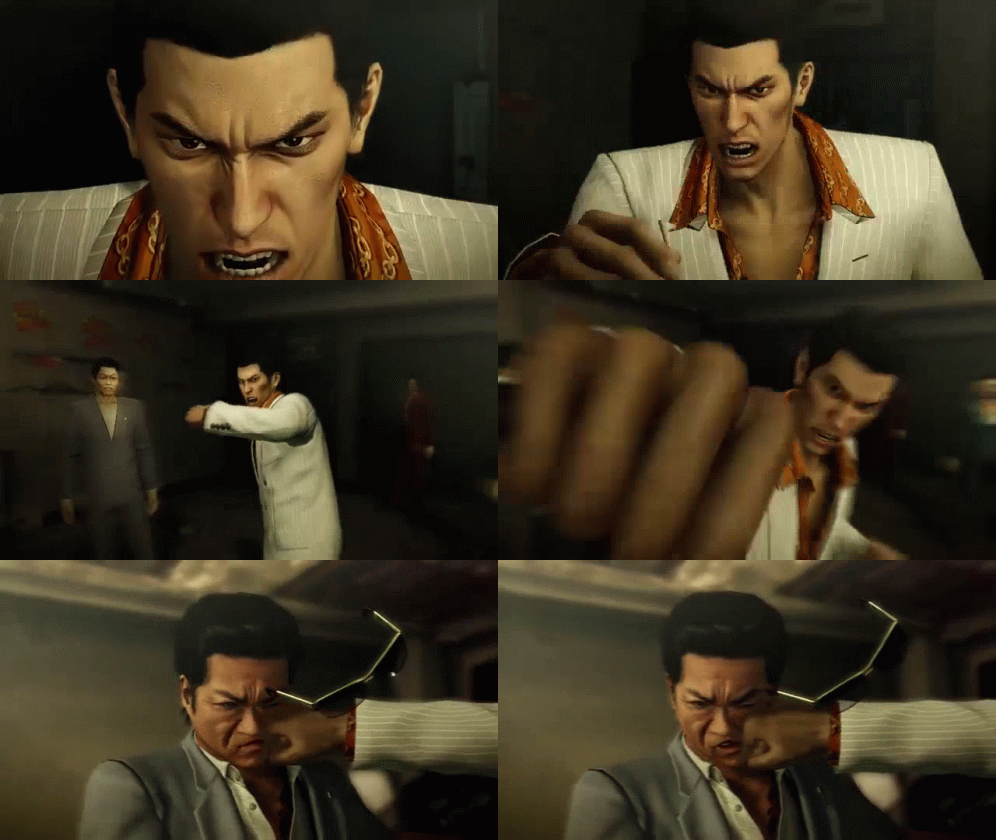
My read is that the game is telling us that violence does not, cannot, provide meaning. The endless street brawls and Kuze being a dick yet again are only water to tread until the next moment that matters. The yakuza world says might makes right, but this violence provides no solutions. It is impossible for a stable structure to be built upon this. Time and again we fight and we win, and the repetition shows us that nothing is gained. The fights begin to blur together, every victory hollow and insubstantial, nothing changing. Defeat Kuze and he returns. You beat up street thugs and they return. There is motion but there is no consequence. And that is the critique of violence: it is fundamentally empty. It is not about if violence is brutal, or the moral merits for and against it. It is about the fact that violence cannot build, it can only maintain or destroy. It does not connect, it separates. It cannot give meaning, only fill the time between moments that do matter.
The sub-stories are evidence of this. They offer demonstrations of what is needed for sustainable solutions, which is not a pair of fists. Instead these answers come from having an open mind and kind soul, from something built from communication and empathy.
Take Kiryu’s sub-story with the “Damned Yanki.” A hardcore hooligan bumps into you, tries to intimidate you, and runs away. You follow him until you come to a crowd awaiting a performance and panel by the Yokimichi Silvers, a ‘tough’ band. Here you find Krazy Kyo, the hooligan, hiding behind a pole.
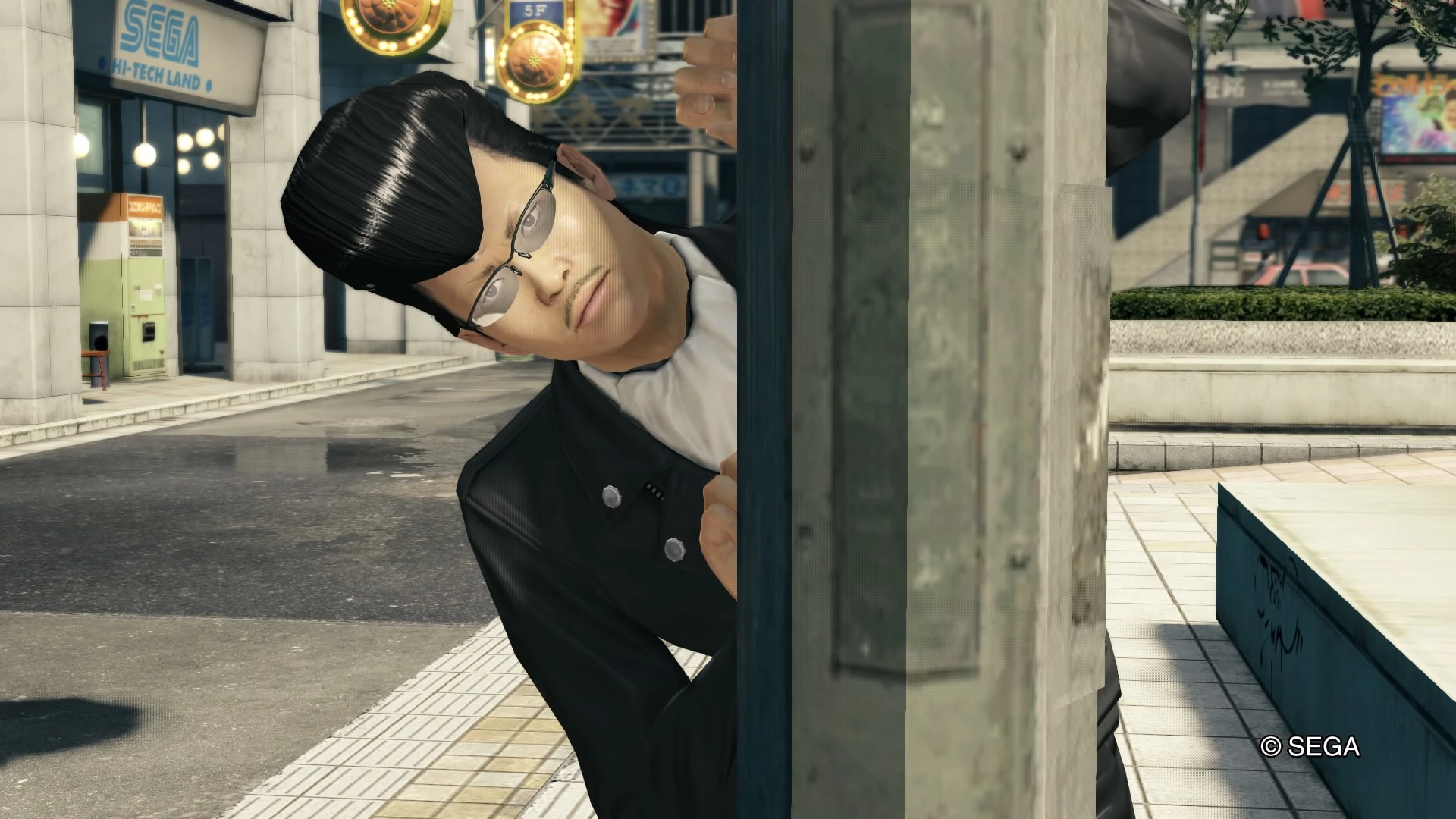
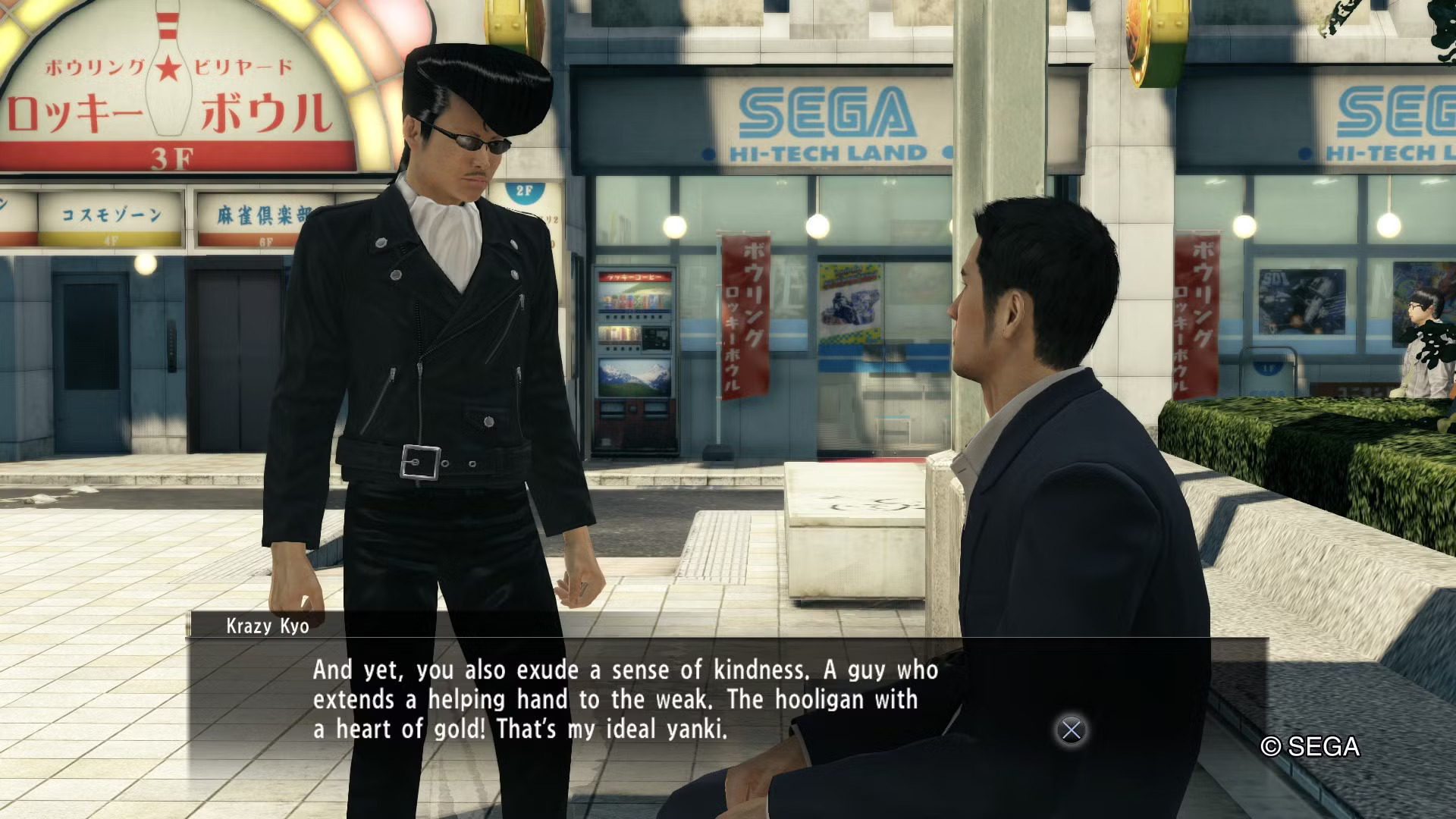
It turns out that Krazy Kyo is the singer for the band that the crowd is here to see, however, he and his band are a fraud; they are not hooligans at all. So he enlists Kiryu for help to make he and his band appear tough and maintain their reputation. Even though this sub story is about being tough, no solution can come about via violence. Instead, a solution is found through mentorship and guidance. Kiryu coaches them how to carry themselves, how to project confidence through authenticity rather than aggression. Real toughness is not about fighting, it is about conviction and believing in yourself and your goals. Kiryu doesn’t beat them up to teach them. Rather, he helps them discover it within themselves through encouragement and understanding. This sub-story teaches us that even when the goal is to appear strong, violence is not the answer. Connection, teaching, and helping someone else find their own strength is the real solution.
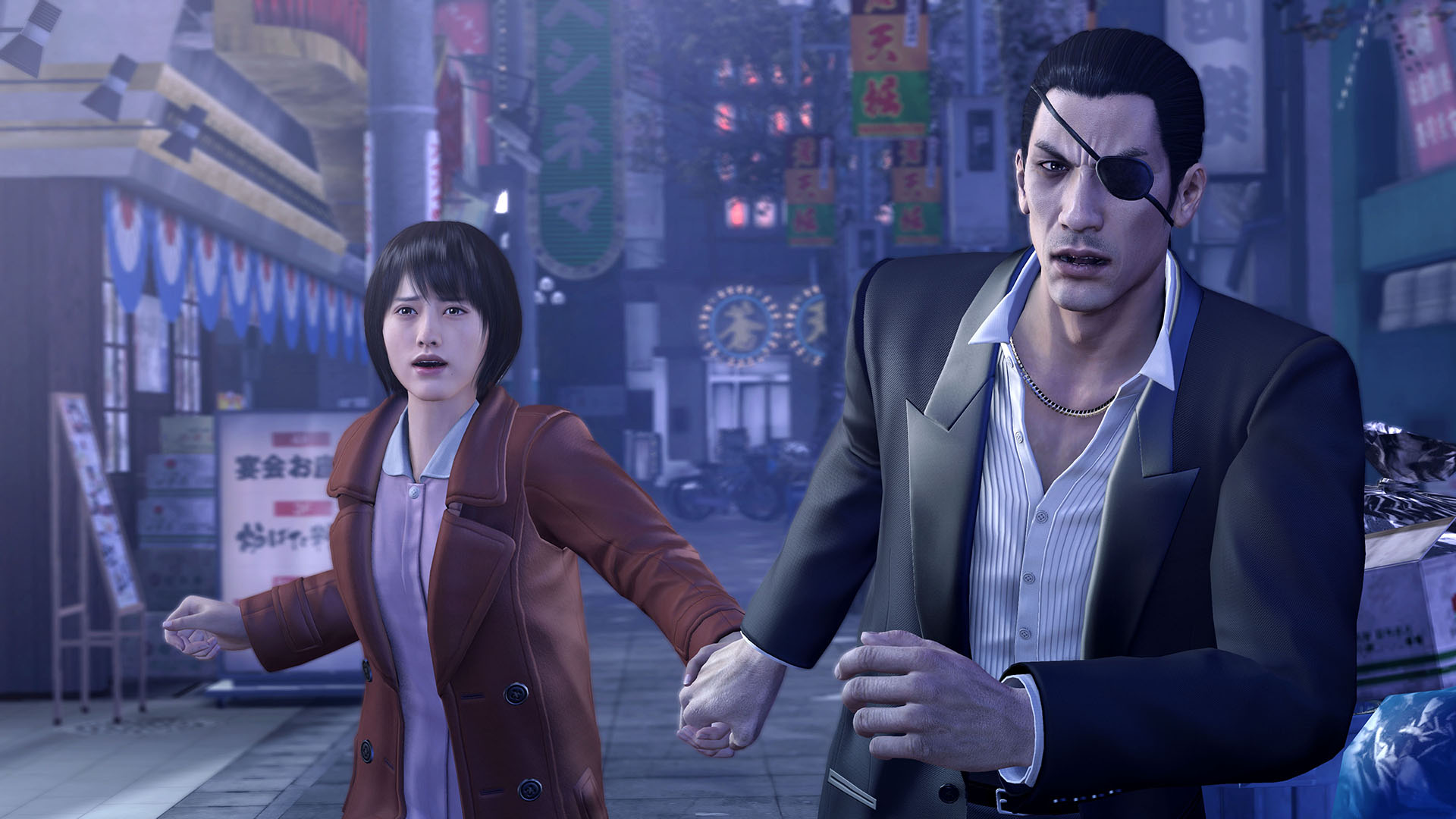
In the silly sub-story, “Be My Boyfriend,” Majima has a young woman, Kokoa, approach him and asks him to be her boyfriend. He is taken aback until the situation is further explained. It turns out Kokoa’s father has been trying to arrange a marriage for her, and in an attempt to make it stop, she told him that she had a boyfriend (who happened to look exactly like Majima). Majima, having the empathetic thought of being trapped in a marriage with someone you don’t know, agrees to help her out.

You meet her father at an eatery where he questions you and you have to match Kokoa’s backstory that was hastily given moments before. When she goes to the washroom, it’s just Majima and the father (“Damn. Awkward.”). He thanks you for going along with his daughter’s made-up story, which confuses Majima. The father says he knows and comes to the realization that “She’s her own woman. It’s time I learned to let go.” Majima then follows with his own bit of insight, saying that the reason Kokoa pulled this stunt is because “I think she was tryin’ to show ya that you don’t need to worry about her so much.” When she comes back to the table, her father agrees that he will no longer try and arrange her suitors. This sub-story is about empathy, understanding, and the ability to help someone see another’s point of view. Majima is demonstrating that which the yakuza world does not value but which creates meaningful change. Violence does not, could not, be a solution here.
But the main story is the yakuza world, and it is a tragedy. A system built on power and control that is fundamentally violent. This world is a place where violence is a means of survival, a necessary attribute that reinforces itself. Both Kiryu and Majima are trapped within this system. Neither can just ‘quit.’ Violence offers them both sweet, false promises: Kiryu, the path to honor and righteousness; Majima, the path back to belonging and status.
Kiryu, the Idealist
Kiryu can win any fight he is in, but none of this strength solves his actual problems. He genuinely believes in values of loyalty, honor, and protecting the weak. He really does try and do things the ‘right way.’ He believes in the code, follows protocol, respects hierarchy. But this keeps failing him because he is loyal to a fundamentally violent system. His honor leads to conspiracy and backstabbing. Dojima’s brutality and the dysfunctionality of his family betrays that loyalty. Kiryu’s proficiency with violence does not resolve the central conspiracy he is roped into. He defeats boss after boss, but this does not stop the power struggle. Violence might be able to clear obstacles, but it does not solve any root problem.
Winning fights does not build the idealistic version of the world he believes in. His violence may be honorable, but that doesn’t prevent the corruption of the system. We are shown that violence, even when performed with good intention, does not provide meaning. His strength is his greatest asset, but his fights do not help him accomplish his goals. His strength is not enough to keep those he cares most about from being vulnerable. Violence can delay harm, but it cannot create safety. It will not give him what he seeks in honor, protection, or belonging. Such things only come about through his non-violent choices.
Still, these meaningful connections are drowned in violence because the system makes violence the only interoperable language of power and resolution. The hierarchies, territorial beefs, the constant demand of proving one’s strength; the structure itself demands the centrality of violence. It is a system that only acknowledges and rewards violent capability. Kiryu continually tries to find meaning through honing violence, such as being the most honorable fighter or the strongest protector, not realizing that it violence is structurally incapable of providing meaning, no matter how righteously it is preformed. The yakuza world does not allow gentle connection primacy, but instead relegates these connections to secondary against the violence that defines yakuza identity.
Majima, the Rebel
When we are introduced to Majima, he is undergoing a psychological torture that erases the boundaries between his public identity and private self. He is constantly surveilled, every choice a test whose results determine his sense of self. He believes that if he behaves well enough, he will be admitted back into the very family torturing him.
Sagawa’s assassination order is the ultimate test of if this violent reconditioning was successful. Majima either complies, having been broken entirely, or he disobeys and loses everything. His decision to not kill Makoto is pivotal, showing that he still has a strong moral code, rejecting violence and instead choosing care. Yet Majima is indoctrinated into the logic of the yakuza world, which means even when he disobeys the assassination order, he does not act outside that logic. His solution is approximately, “I’ll fight everyone who comes after her.” He believes that violence will solve his dilemma. The ideology is so strong that even his conscious rebellion operates within its rules. He doesn’t see it, but the yakuza control all his possible actions.
Majima’s transformation into the Mad Dog can, at first, appear as empowerment. It is not. It is a trauma-based survival strategy. Being unpredictable, theatrical, and chaotic is an armor that may protect, but it also traps. He may feel liberated, but it is the system having finally broken and reconstructed him until his entire identity is a violent performance. The moments that show his humanity, the ones that change him, are the non-violent ones.
His connection with Makoto is non-violent. What matters with her is that he is present and listening, that he has been given something to protect beyond his own self-interest. It is this relationship building that creates his character transformation, not his exceptional fighting ability. And his final defining choice is to not reveal himself to her: restraint and sacrifice. These are acts of care, vulnerability, and letting go. His story tells that violence, even rebellious violence, cannot heal, cannot give authentic identity, and cannot create real connection. Violence is a constant in Majima’s world. Meaningful moments are found in everything that violence cannot be.
Trapped Without a Key
Violence is the defining concept of Kiryu and Majima’s worlds. Kiryu believes that violence can be honorable and meaningful; Majima uses violence to survive and rebel. The game shows that despite the fact they are exceptional fighters, or perhaps because of this, Kiryu cannot fight his way to his idealized world and Majima cannot fight his way to freedom. Their mastery of violence is a mastery of nothing. Their identities are so tied to being yakuza that violence keeps them in place, powerful yet paralyzed, neither able to escape.
Despite this trap, they are each able to find meaning. Kiryu finds it through trust, loyalty, and partnership. Majima find it through protection, vulnerability, and sacrifice. It’s these choices that are their defining moments, not the cinematic boss fights. Their growth, humanity, capacity for meaning; all these come from non-violent actions that the yakuza world does not value nor accommodate. But we are playing a prequel knowing it is a tragedy, and so despite these glimpses into different worlds of meaning, we know Kiryu doesn’t escape and that Majima’s Mad Dog personality becomes permanent. The game shows us their humanity and capacity for meaningful care, and that these capabilities are not strong enough to break their cage.
Yakuza 0 shows that systems of power trap people through a rewriting of identity, imagination, possibility itself, something that is magnitudes stronger than physical entrapment. Kiryu and Majima have been convinced by the yakuza world that violence is who they are, that no other alternative life is available to them. This is reinforced by the game’s structure, where violence is constant and hollow, non-violence is rare and transformative. Yet these meaningful moments cannot overcome this violent system. So the Empty Lot is a perfect metaphor: the entire conspiracy revolves around nothing. Violence and suffering for a void in the center. Kiryu and Majima are trapped in this void, powerful and skilled at something that cannot free themfrom this world. The game shows us the cage, the prisoners, what lies beyond the bars. But it never shows us the key to get out. Perhaps that is because the system is so totalizing there is no key.